.png)
❌ Myth buster: Less reduction means more removals ❌
- sebmanhart

- Apr 19
- 2 min read
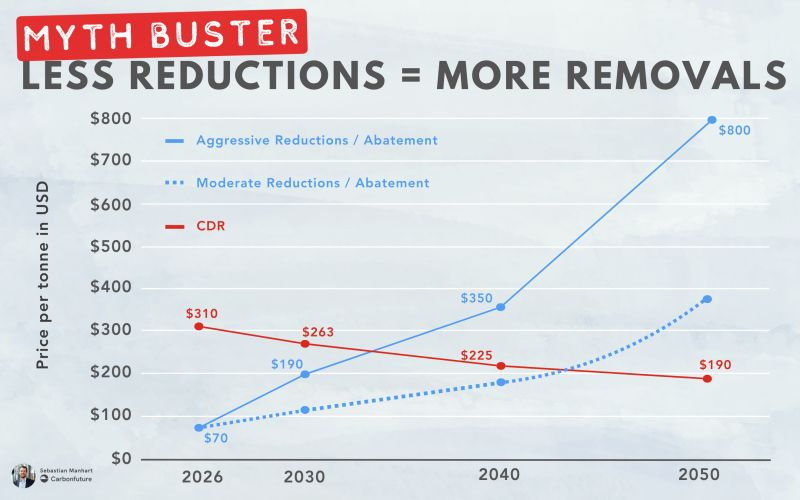
👂 I keep hearing this. And - on the surface - it makes sense. Every ton we do not reduce will have to be removed.
📈 However, the simple economics of abatement and removals tell a different story: The less we reduce, the more unlikely we will remove.
To understand this argument, we need to look at two cost curves:
🔴 Carbon dioxide removals (CDR): this one is straight-forward. Using a blended ton of durable removal, we are averaging $310/t today and predictions see us getting to around $190/t by 2050.
🔵 Reduction / abatement: today, it costs on average $70/t, because we are still tackling the low-hanging fruits (first 25%). As we reach around 50% of overall reductions, we are looking at around $1 50/t. At 75% we are already at $340/t, and then it increases exponentially the closer we get to 100%.
🫰 As you can see from this graphic, the cost curves cross at around $250/t in the early 2030s. This means that from that point onwards - likely the final 30% of emissions - carbon removals would become more cost-effective than reductions.
⚠️ HOWEVER, until we reach that point, CDR will remain a luxury, supported by some but simply not the most effective tool to achieve net-zero. If we delay reductions, that intersection point keeps shifting into the future.
👉 In other words, until we reach around 70% of emission reductions, CDR will not scale.
🙅 This is why any effort to delay emission reductions might increase the need for CDR, but at the same time reduces the likelihood of this CDR ever emerging.
That, my friends, is why:
1️⃣ We all need to push for emission reduction above everything else
2️⃣ Your killer argument for the nonsensical moral hazard argument made against CDR
🤔 Thoughts?


Comments